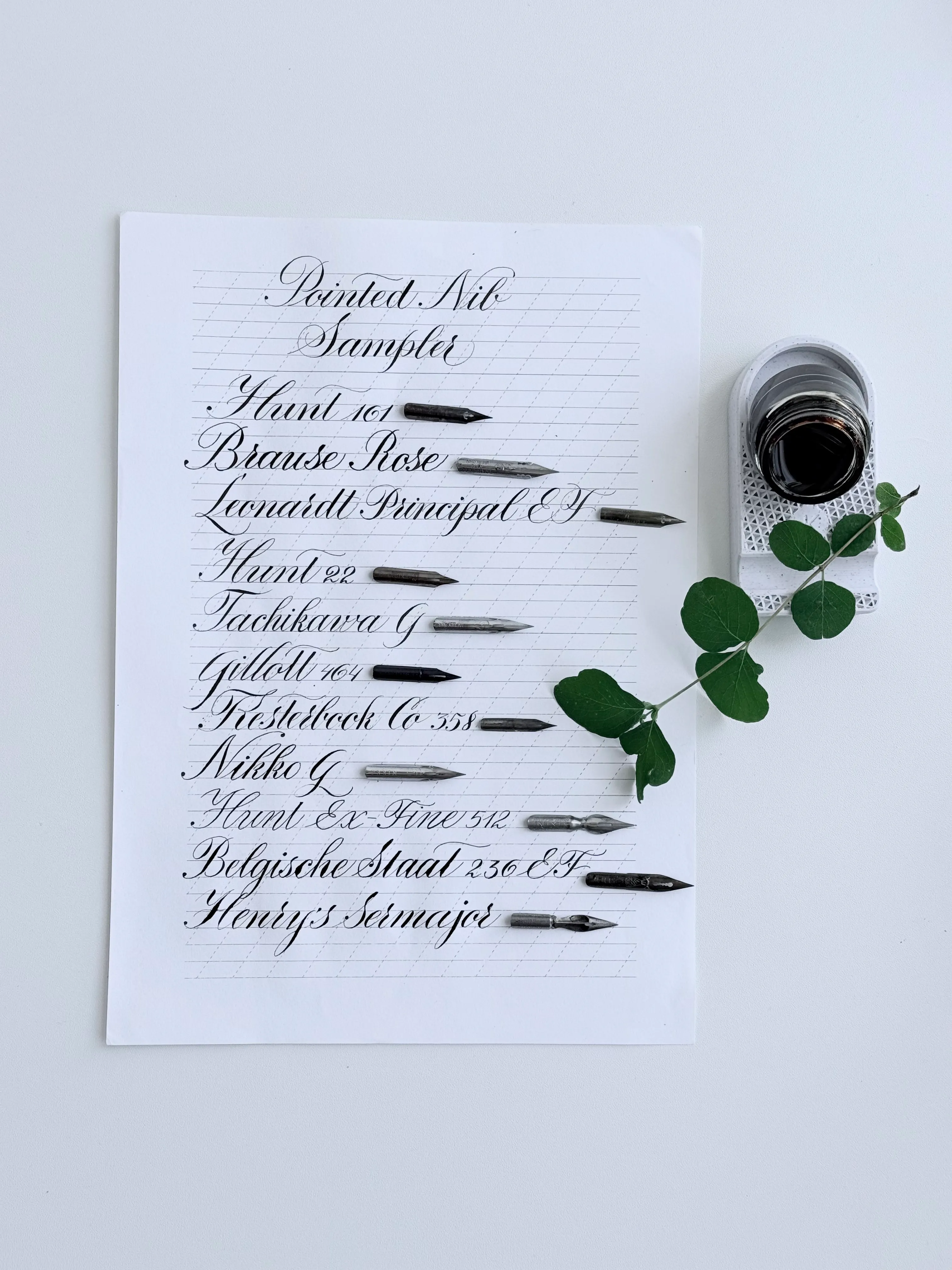
Choosing a nib is personal. What feels perfect for one calligrapher can feel completely wrong for another. I’ve been testing and comparing pointed pen nibs for a while now, and I wanted to share my honest impressions — what I love, what I don’t, and what each one is really best for.
Hunt 101 — My everyday nib
This is the nib I mostly write with. Love its flexibility and good control. It’s not scratchy, easy to work with, and doesn’t splash. Looks really good on larger Copperplate script. Love how easily it allows variations in flourishes.
Characteristics: Extremely flexible, capable of producing very fine hairlines and dramatic swells.
Best for: Copperplate script, flourishing, Ukrainian cursive.
Note: Requires a light hand due to its high flexibility. Usually, such nibs aren’t recommended for beginners, but I think it depends a lot on your temperament. I’ve used it almost from the start and love the writing experience way more than with stiff or moderately flexible nibs.
Leonardt Principal EF — A new favorite?
Strangely, I’d never tried this popular nib before — but I fell in love immediately! Such astonishing control combined with huge stroke variety. The script came out clean even while adjusting to it. I’ll definitely write more pieces with it — I have a feeling it may become my favorite.
Characteristics: Sharp point, very flexible, capable of great line variation.
Best for: Spencerian and Copperplate.
Note: Best experience requires smooth paper.
Brause Rose — Wild and expressive
I’ve never used this nib before — and it feels crazy! So soft and flexible! I don’t like how it works with more structured script, but I’ll definitely try it for gestural calligraphy. I think it would be great for large, free strokes. Definitely not an easy nib. You need to build some trust — get used to each other — to really let loose. But the potential is limitless.
Characteristics: Soft and springy. High ink capacity.
Best for: Expressive Copperplate, gestural writing, or modern calligraphy.
Note: Delicate and can feel too soft at first.
Resterbook Co. 558 — Vintage magic
This is one of my vintage nibs. I have more of them, but due to their delicate structure, they break easily. Still, writing with this nib is truly inspiring. The stroke variation is extreme! I love how it moves from hairline-thin to rich, heavy strokes. However, this one is scratchy — you’ll definitely need time to adjust your pressure.
Characteristics: Less common nib, very flexible.
Best for: Expressive Copperplate with flourishes, Ukrainian cursive, modern calligraphy.
Note: Watch for splashes, especially if that’s not what you’re going for.
Hunt 22 — Controlled and precise
Since I’m used to flexible nibs, this one felt pretty restrictive in terms of contrast. Still, it offers good stroke variety. I think I’ll try it for Copperplate (for more delicate works with smaller script) and Spencerian.
Characteristics: Moderately flexible, durable, with a finer point than Hunt 101.
Best for: Delicate Copperplate script with smaller characters. Gives plenty of control, so I’ll definitely try this one for beginners.
Note: A great balance of control and stroke variation.
Tachikawa G — The beginner’s friend
When I started studying Copperplate, I used the Nikko G, but I actually love this one much more. It’s not made for expressive calligraphy, but it gives comfort and amazing control. I’d recommend it to beginners to learn the structure of Copperplate or Spencerian.
Characteristics: Durable Japanese nib with moderate flexibility.
Best for: Copperplate and Spencerian for beginners.
Note: Smooth writing, especially for those used to moderate stiffness. Has more ink capacity than the Nikko G.
Gillott 404 — Not for me (but useful)
I’ve written with this nib for a long time and can confidently say I don’t like it! However, it works on surfaces that other nibs can’t handle.
Characteristics: Moderately flexible, fine point.
Best for: Writing on difficult surfaces, mono line scripts, graphics.
Note: Less dramatic line variation than other nibs.
Final thoughts
Every nib has its personality. The Hunt 101 remains my daily driver for its perfect balance of flexibility and control — but the Leonardt Principal EF is quickly winning me over. If you’re just starting out, grab a Tachikawa G and focus on learning the letterforms. Once you’re comfortable with pressure control, try something more flexible — you might surprise yourself.
The best nib is the one that makes you want to keep writing.